
Reviewed · BOGOTA TOURS
Fun Graffiti Workshop: The Art of Aerosol and Color
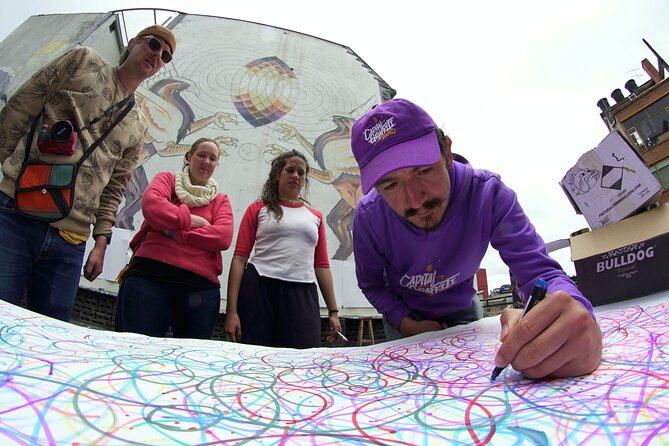
Bogotá’s graffiti culture makes more sense once you hold a spray can yourself. At this two-hour workshop, you invent a graffiti name, sketch it, and paint it in a 3D throw-up style on a wall at Ocio Gallery. The instructor breaks down dots, lines, spirals, can control, and color before you tackle the finished piece.
I like the mix of hands-on art and local gallery culture, plus the small maximum of 10 people. You also visit a cultural house filled with Colombian prints, clothing, murals, and pictures from the experience. The main caution is practical: some cans may be empty or nearly empty, which can limit your color choices.
Key points at a glance
- Start with spray-can basics: Practice dots, lines, and spirals before designing your tag.
- Create your own graffiti name: The goal is a personal signature, not a copied souvenir design.
- Paint on a real courtyard wall: Your paper plan becomes a large 3D throw-up piece.
- Meet at Ocio Gallery: The art-filled gallery adds a cultural stop before the workshop begins.
- Small group setting: The activity accepts no more than 10 people, though the pace can change with family groups.
- Budget for extras: The $58 price includes art supplies and wall space, but not transportation, food, or tips.
Turning a Name Into a Bogotá Graffiti Tag
The best part of this workshop is its clear goal. You are not simply waving a can at a wall and hoping for the best. You create a graffiti name, work out its shape on paper, choose colors, and then turn it into a bold 3D throw-up.
That structure matters if you have never used spray paint. A blank wall can feel intimidating, especially when the paint comes out faster than expected. The workshop gives you a path from simple hand exercises to a finished tag that has some shape and personality.
The instructor begins by explaining the plan, showing the available materials, and asking permission to take pictures. You then get a short warm-up for your body and hands. It sounds minor, but loosening your grip and shoulders helps when you are trying to control a can at arm’s length.
You will also see how to shake the cans properly. The instructor uses the can in the air to mimic a giant signature, a simple demonstration that shows the motion behind graffiti lettering. This kind of physical explanation is useful because graffiti is not just drawing. It involves pressure, distance, speed, and movement.
A few more Bogota trips to weigh up
- Bogota: Colombian Emerald Ring Workshop
★ 5.0 · 61 reviews - Private Salsa Class and / or Latin Rhythms
★ 5.0 · 54 reviews - Fun Graffiti Workshop: The Art of Aerosol and Color
★ 5.0 · 3 reviews
Ocio Gallery Adds More Than a Meeting Point
The workshop begins at Ocio Gallery, at Cra. 5 #26b-26 in Bogotá. You do not walk straight from the street to a bare painting area. First, you have a chance to look around a gallery filled with prints by Colombian artists.
The gallery also sells printed clothing. If you want a small art souvenir that is easier to pack than a canvas, this gives you another option. The gallery can also be worth a stop on its own, especially since it is close to La Perseverancia Market and several places to eat.
That location gives the activity a useful local setting. You are not painting in an isolated studio with no connection to the city. The gallery, the nearby market, and the courtyard murals place the workshop within Bogotá’s art scene, even though the class itself remains focused and beginner-friendly.
The included visit to the cultural house is another plus. You can see unusual murals and pictures connected with the experience. The supplied details do not promise a long guided tour of the neighborhood, so I would think of this as a compact cultural visit rather than a full walking tour of Bogotá’s street art.
The Warm-Up Makes Spray Paint Less Intimidating
After the introduction, the class moves into basic exercises. You practice dots, lines, and spirals, gradually getting a feel for the can and nozzle.
For a first-time painter, this is the right order. You learn how the paint leaves the can before you risk your name on the wall. The exercises also reveal how much control comes from hand movement. A quick pass creates a different mark from a slow one, and distance changes the width and strength of the line.
The supplies are included: spray cans, graphic markers, nozzles, thick paper, and wall space. The paper is important because you can plan your tag before committing to paint. You are not expected to invent a full design while standing in front of a wall with a can in your hand.
The instructor helps you shape the name and plan the project. Depending on the group, you may get ideas and pointers as you develop the lettering. The teaching is practical rather than academic. You learn by trying, adjusting, and trying again.
Planning the 3D Throw-Up on Paper
The central design is a throw-up, a quick, bold graffiti form with large letters and a 3D effect. The workshop asks you to invent a name first, which gives the finished work a personal hook.
You sketch with graphic markers on thick paper, working out the basic form and color plan. This step gives you room to change the spacing, letter shapes, and shadows before you spray.
I like this approach because it keeps the class from becoming a simple paint-by-numbers exercise. You are given a style to work toward, but your name and choices remain your own. The instructor can then help make the lettering read clearly and look more forceful.
Color choice is part of the planning. In theory, you select colors that help the letters and 3D effect work together. In practice, the available cans matter. One class had several empty or nearly empty cans, leaving fewer colors to choose from. That problem is not central to the idea of the workshop, but it can affect the final result.
If color variety matters greatly to you, it is worth keeping this possible limitation in mind. A restricted palette does not ruin the exercise, but it can make the design less like the one you first imagined.
Same city, a completely different kind of day:
- Bogota: Bicycle City Tour
★ 4.9 · 2,156 reviews - Zipaquirá: Salt Cathedral Group Tour with Pickup
★ 4.8 · 1,606 reviews - Bogotá: Guided La Candelaria Walking Tour
★ 4.8 · 1,229 reviews - Bogotá: Private City Tour, Monserrate, Emerald and Botero
★ 4.9 · 798 reviews
From Paper to the Courtyard Wall
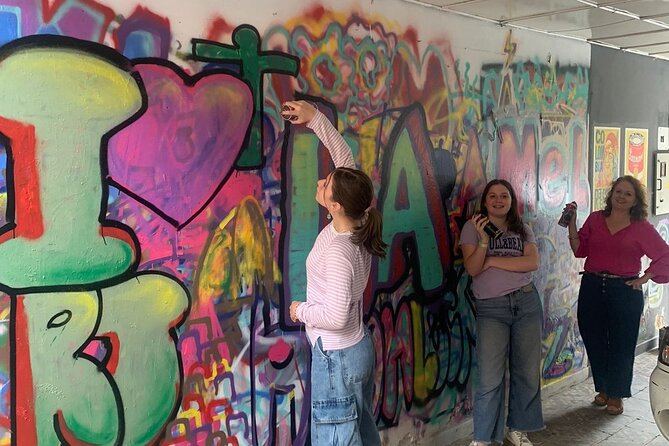
Once your plan is ready, you move to the courtyard behind the gallery. The walls are covered with experiments and tags from earlier participants, so the painting area already feels like a working art space rather than a spotless classroom.
This is where the workshop becomes more memorable than a paper-only art lesson. You get to see how your design changes when it grows in size. Letters that looked balanced on paper may need more space on the wall. A line that seemed thick enough may disappear beside a larger form.
The instructor coaches you while you work and helps shape the finished tag so it pops. That support is especially useful when you begin filling large letters or adding the 3D effect. You can focus on the basic mechanics while the instructor points out ways to strengthen the overall form.
The result is not meant to turn you into a professional graffiti artist in two hours. It gives you a controlled first encounter with the tools and visual language. You leave with a better sense of how much planning goes into a tag that appears quick and casual on a city wall.
The Instructors and Teaching Style
Cali, who works professionally under the name TET, led one workshop and is connected with works on walls around Bogotá. He began with simple exercises, offered ideas, and coached the design through to the final tag.
Diego is also identified as a guide for the experience, and he has worked well with families and children during the two-hour class. The exact instructor may vary, so you should not book with the assumption that one particular person will lead every session.
The teaching style described here suits beginners. You get demonstrations, practice, planning, and hands-on help rather than a long lecture about graffiti. The instructor also presents the process with energy, using movement and visual examples to make the technique easy to follow.
This activity works best when the guide has enough space to help each person. The maximum group size is 10, which is a reasonable limit for a hands-on art class. Still, the total number does not tell the whole story. A group of focused adults will move differently from a group that includes several young children.
A Good Family Activity, With One Important Catch
The workshop can work well for families. Diego has been interactive with children, and the format gives kids a direct way to make art rather than just look at it. The two-hour length is also manageable for a family outing.
But you should think about the age and behavior of your group. One session included four children around age eight or younger, and some adults became less involved while the children ran around. That changed the feel of the class for the adults who wanted a focused art lesson.
This is not a fault in the graffiti instruction. The organizers cannot know in advance how each group will behave. Still, if you are booking as an adult or with older children, it may be worth asking about the expected group makeup when possible.
For families, I would frame the class as a shared creative activity, not a formal art course. For adults seeking concentrated instruction, the experience may be best when the group is calm and engaged.
What the $58 Price Really Covers
At $58 per person, this is not the cheapest way to spend two hours in Bogotá. The value comes from the combination of instruction, materials, a gallery visit, a cultural house, and wall space.
You are not paying only for a can of paint and a blank sheet. The price includes spray cans, graphic markers, nozzles, thick paper, and access to the courtyard wall. It also includes the setting at Ocio Gallery, where you can see Colombian prints and printed clothing before or around the class.
The experience works out to about $29 per hour before considering the art materials and gallery access. That seems fair if you want a guided creative activity and would not otherwise know where to paint legally or how to begin.
The value is weaker if you mainly want to see Bogotá’s famous street art from the outside. This is not a broad city tour, and it does not include transportation, food, or tips. You also need to reach Ocio Gallery on your own.
I would compare it with the cost of a regular creative class in your home city. Here, the difference is the setting and the link to Bogotá’s graffiti culture. You get to make a piece in a city known for public art, with an instructor who can connect the exercises to real graffiti practice.
Planning Your Visit to Ocio Gallery
The activity starts and ends at Ocio Gallery, so you do not need to arrange a separate return transfer. The meeting point is near public transportation, which helps if you are moving around Bogotá without a private car.
Transportation is not included. Build that cost and time into your plan, especially if you are staying far from the gallery. Since the workshop lasts about two hours, it can fit into a morning or afternoon, but the exact start time should guide your plans.
The activity is generally open to most people. The supplied details do not list special physical requirements, but the warm-up and spray-paint work involve standing, moving your hands, and working at a wall. If that could be an issue for you, ask the provider before booking.
Reservations are often made about 34 days ahead, so this is not an activity I would leave until the last day of a short Bogotá visit. Confirmation arrives within 48 hours, subject to availability. The group limit is 10 people.
You can cancel for a full refund if you do so at least 24 hours before the local start time. A late cancellation or late change is not refunded, and the class requires a minimum number of people to operate. If that minimum is not met, you are offered another date or experience, or a full refund.
What to Bring and What Not to Expect
Your core art supplies are provided, including spray cans, markers, nozzles, paper, and wall space. You do not need to arrive with your own paint.
Wear clothing you can relax in around spray paint. The supplied information does not promise protective clothing, food, or drinks, so plan accordingly. I would also avoid booking the class immediately before an important meal reservation if you want time to look around Ocio Gallery and eat nearby afterward.
Do not expect to produce a museum-quality mural in one session. The goal is a first experience with a particular graffiti style. Your finished tag may be rough around the edges, and that is part of learning how the medium behaves.
You should also expect the available colors to shape the result. A few cans may be empty or low, and the color selection can be limited. The instructor can still help with the design, but your planned palette may need to change.
Who Will Get the Most From This Workshop
I would recommend this class to you if you want to do more than photograph Bogotá’s street art. It gives you a chance to understand the hand movement, planning, and quick decisions behind graffiti lettering.
It is a good fit for:
- Beginners who have never used spray paint.
- Families looking for a two-hour art activity.
- Visitors who enjoy prints, murals, and artist-made clothing.
- Adults who want a small-group creative experience.
- Anyone interested in making a personal souvenir rather than buying one.
I would be more cautious if you want a quiet, tightly controlled class with a guaranteed range of colors. The group can include families with young children, and the supplies may not always be fully stocked.
The workshop is also not the best choice if you want a full Bogotá street-art tour. You will work on a courtyard wall and visit the gallery and cultural house, but the focus is making your own tag.
Should You Book the Graffiti Workshop?
Book it if you want a practical connection to Bogotá’s graffiti culture and like the idea of making your own 3D tag. The strongest reasons are the thoughtful progression from warm-up exercises to paper planning to wall painting, the gallery setting, and the chance to work with an instructor such as Cali, known as TET, or Diego.
At $58, it offers solid value for a guided art session with supplies included, especially if you would otherwise have no idea how to start with spray paint. Just keep your expectations flexible about color availability and group behavior.
For the best match, book this as a creative cultural activity, not as a sightseeing tour. Adults and families who enjoy making things will likely get the most from it. If you are ready to shake a can, invent a name, and accept a few imperfect lines, this is a lively and personal way to spend two hours in Bogotá.
FAQ
How long does the graffiti workshop last?
The workshop lasts approximately two hours.
How much does the experience cost?
The listed price is $58 per person.
Where does the workshop start?
It starts at Ocio Gallery, Cra. 5 #26b-26, Bogotá, Colombia.
Where does the activity end?
The activity ends back at the Ocio Gallery meeting point.
Are spray-paint materials included?
Yes. The experience includes spray cans, graphic markers, nozzles, thick paper, and wall space.
Is the workshop suitable for beginners?
Yes. It is designed for beginners and people with no previous spray-paint experience.
How many people can join the workshop?
The activity has a maximum of 10 participants.
Can I cancel for a full refund?
Yes. You can cancel at least 24 hours before the local start time for a full refund. Cancellations or changes made less than 24 hours before the start are not refunded.
Just added around Bogota
- Bogotá: Graffiti Tour el mejor recorrido de arte urbano★ 4.7 · 41 reviews
- Shared Tour of Colombian Exotic Fruit at Paloquemao Market★ 4.7 · 20 reviews
- Shared Tour to Monserrate Hill and Gold Museum in Bogota★ 4.9 · 8 reviews
- Shared Tour Bogota’s Street Local Food★ 4.5 · 22 reviews
- Shared Tour Colombian Conflict War, Drug Trafficking & Peace★ 4.8 · 46 reviews
- Paragliding Activity with Transfers from Bogota★ 4.9 · 21 reviews
- Monserrate Express tour 3 hrs★ 4.6 · 6 reviews
- Nemocón Salt Mine Tour★ 5.0 · 3 reviews
Bogota Tours, compared.
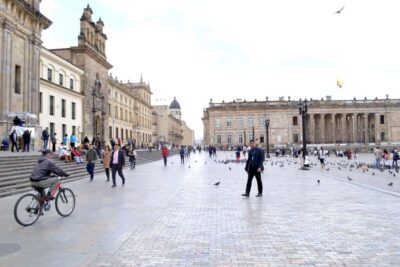
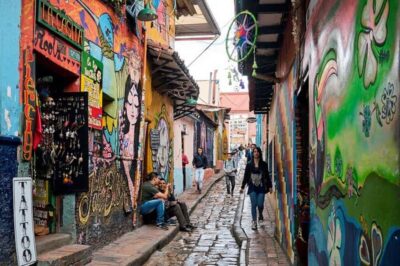
Private City Tour, Monserrate, Emerald and Botero
Read our review →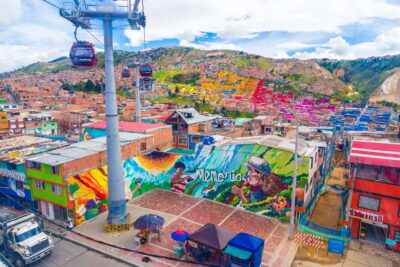
Bogotá´s Barrios: El Paraíso Favela Tour with Cable Car
Read our review →
Bogotá City Tour with Monserrate, Gold and Botero Museums
Read our review →
Zipaquirá Salt Cathedral and Lake Guatavita Day Tour
Read our review →Browse the lists this tour appears in