
Reviewed · WALKING TOURS
Private 4-hour walking tour of Cartagena with official tour guide
Cartagena’s past comes in layers: Carthaginian walls, Roman ruins, medieval defenses, naval tradition, and grand modernist buildings all sit within an easy city walk. This private four-hour tour gives you a guide’s full attention while connecting those pieces into one clear story, rather than leaving you to inspect scattered ruins on your own.
I like the inclusion of the Roman Theater and Museum, the city’s major ancient sight, and the choice of morning or afternoon departures. I also like the personal approach. Guides such as David, George, Rosel, and Gema have been praised for making the city understandable, adjusting the pace, and adding practical touches such as a good gelato recommendation.
The main caution is price: at $260.07 per person, this is a serious outlay, especially for solo visitors or couples. Several other admission fees are extra, and the walking route includes stairs and uphill sections, though the guide can adjust the pace.
Key points to know before booking
- The Roman Theater is the centerpiece: Admission to the theater and its museum is included, giving you access to Cartagena’s most important ancient monument.
- You get a private guide: Only your group takes part, so you can ask questions freely and request a slower pace or more time at a favorite stop.
- The route covers several eras: You move from Spanish naval history to Carthaginian remains, Roman public buildings, a medieval castle, and modernist architecture.
- Castle access is limited: The tour includes the panoramic elevator to Torres Park and an exterior view of the castle, but the castle admission fee is not included.
- Some costs remain separate: The Punic Wall and Castle of the Conception have additional admission charges, while food, drinks, and transportation are also excluded.
- Plan for four hours of walking: The route is manageable for most people, but stairs and climbs matter. Rosel, in particular, has adjusted the pace for people who needed regular breaks.
Why a private walk makes sense in Cartagena
Cartagena is not a city where every important sight announces itself. A modern street may cover a Roman forum. A dramatic ruin may sit below a museum entrance. A medieval castle may occupy a hill once used by earlier civilizations. Without context, you can see the remains but miss the connections.
A private guide helps solve that problem. You can stop to ask how Qart Hadast became Carthago Nova, why the Roman Theater vanished beneath later buildings, or how Cartagena’s old center acquired its modernist façades. You do not have to keep pace with a large group or wait for a fixed explanation to finish.
The private format also matters for walking comfort. Cartagena’s historic center includes slopes, stairways, and uneven surfaces. If you are traveling with older relatives, children, or anyone who tires easily, tell the guide early. Rosel’s approach, checking in about breaks and changing the route pace when needed, is exactly what makes a private tour more useful than a rigid group outing.
The tour lasts about four hours and offers morning and afternoon starts. A morning departure may leave you with time for lunch and independent sightseeing. An afternoon start can work well if you arrive in the city later or prefer a slower morning, though the best choice depends on the day’s opening arrangements at the paid sites.
A few more Cartagena trips to weigh up
- Cartagena: Historic Center and Getsemaní Shared Walking Tour
★ 4.9 · 2,716 reviews - Cartagena: Walled City and Getsemani Shared Walking Tour
★ 4.5 · 352 reviews - 3 Tapas Cartagena walking tour
★ 4.5 · 105 reviews
Starting with Spain’s naval story
The first listed stop is the Museo Naval, or Naval Museum, with about 40 minutes set aside. Admission is included at no cost, and the museum gives you a useful opening chapter before the ancient ruins begin.
The collection covers the Spanish Navy, shipbuilding, nautical science, navigation, maritime voyages, underwater archaeology, and other parts of Spain’s seafaring tradition. That range matters in Cartagena, a port city whose identity has long been tied to the sea.
I like this as an opening because it prevents the tour from becoming a parade of disconnected stones. You begin with the city’s broader maritime role, then move backward and forward through its military and urban past. Your guide can help you decide which displays deserve close attention during the limited visit.
Forty minutes is enough for an introduction, not a full museum study. If naval technology is your main interest, you may want to return independently. On this tour, the museum works best as context for the city rather than as the sole attraction.
The castle hill and views from Torres Park
Next comes the panoramic elevator to Torres Park, followed by an exterior view of the Castle of the Conception, also called the Castle of Asdrubal. The castle is a medieval structure from the 13th or 14th century, built over earlier Roman and Arab remains.
That layering is the point. The castle’s lantern, preserved from the Arab period, once served as a lighthouse. From the hill, your guide can explain how the high ground shaped Cartagena’s defenses and why the site mattered long before the medieval building appeared.
The elevator makes the climb easier, but this is not the same as a full castle visit. The tour includes the elevator and exterior viewing, while the castle admission fee is not included. If entering the castle is essential to you, check the additional cost and available time before booking.
The hill also gives you a break from close-up archaeology. You can look across Cartagena and understand its compact shape, fortified heights, and connection to the harbor. The view is one of the tour’s better moments for orientation, especially early in your visit.
Entering the Roman Theater and Museum
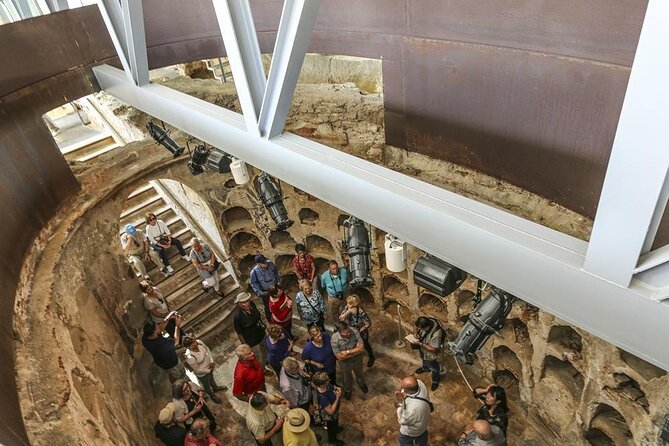
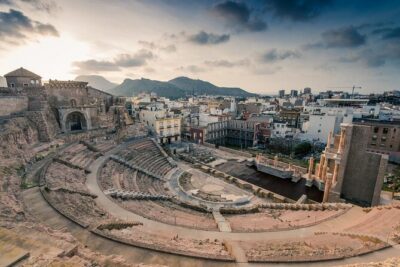
The Roman Theater is the major included admission and the strongest reason to choose this tour over a basic city walk. Built between 5 and 1 BC, it held about 7,000 spectators and remained in use until the third century.
The site was later buried beneath other buildings and only excavated in 1988. That makes the visit more than a look at old seating rows. You see how a major Roman performance space disappeared inside the later city, then returned to public view through modern archaeology.
The Roman Theater Museum, designed by architect Rafael Moneo, leads you toward the monument itself. The museum is part of the experience, not just a separate display room. It helps explain the objects, building phases, and urban setting before the theater opens up in front of you.
Allow the full 40 minutes to this stop. Your guide can point out the scale of the structure and explain why it was one of the largest theaters in Roman Hispania. You also get a clearer sense of how much of the theater was cut into the rock.
Because admission is included, the value here is easy to understand. A private guide can add meaning to a major paid site without forcing you to arrange a separate visit. If the Roman period is your main reason for coming to Cartagena, this stop alone gives the tour a strong foundation.
Same city, a completely different kind of day:
- Cartagena: Rosario Islands Catamaran with Lunch and Snorkel
★ 4.5 · 2,479 reviews - Full-Day Rosario Islands Including Barú, Bocachica & Playa Blanca
★ 4.0 · 1,729 reviews - Cartagena de Indias: 2-Hour Sunset Cruise
★ 4.7 · 1,105 reviews - 2-hour tour in Cartagena Sunset View in party boat
★ 4.6 · 899 reviews
Cartagena’s modernist center and marble City Hall
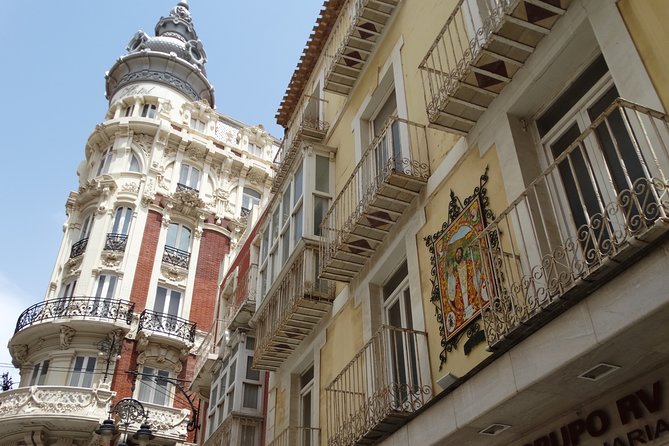
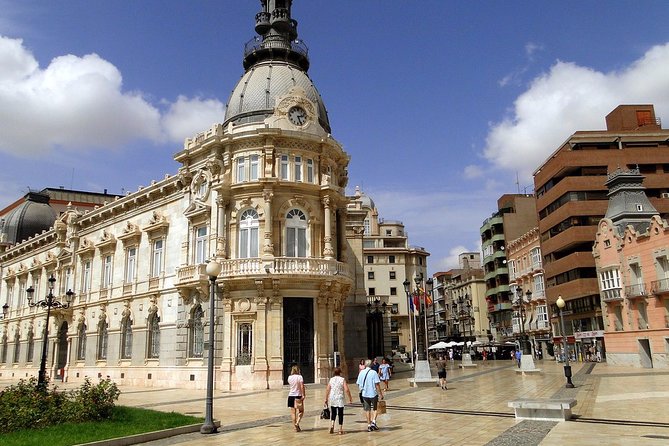
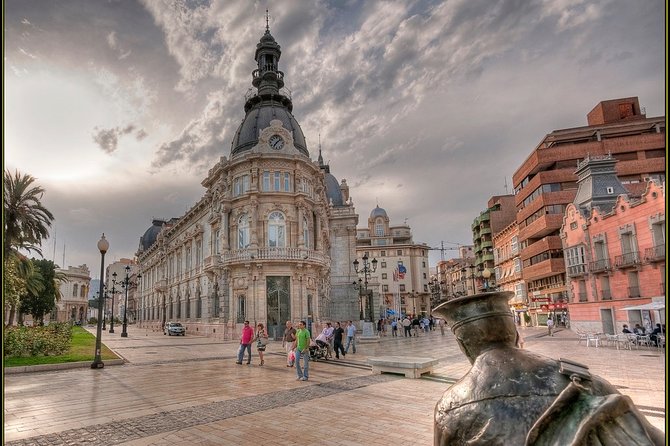
The route also passes the Consistorial Palace, Cartagena’s City Hall and one of the city’s important modernist buildings. Built between 1900 and 1907, it has a triangular plan, white marble façades, and zinc domes on the roof.
Its decoration repeatedly uses Cartagena’s emblems, including the Castle of the Conception and the mural crown associated with Scipio Africanus’s capture of the city. Those details connect a relatively recent building to much older civic symbols.
This is a useful reminder that Cartagena is not only an archaeological destination. Its identity was reshaped in the early 20th century, and the city center reflects that period through grand public architecture.
Another stop is an impressive 18th-century building on the main pedestrian street of the old center. The details supplied for the tour do not identify the building by name, so your guide’s explanation will be particularly useful here. Treat this part of the walk as a chance to read Cartagena’s streets and façades, not simply as a transfer between ruins.
The Roman forum at Cerro del Molinete

The Cerro del Molinete Archaeological Park gives you another look at Carthago Nova, this time through the remains of its Roman forum. The forum once occupied the center of the city, where major roads met between the hills.
Excavation has revealed parts of several important structures:
- A temple to Jupiter, Juno, and Minerva, the Capitoline triad
- An augusteum
- The curia, where the colony’s government met
- Baths and a palestra from the later imperial period
- A temple of Isis
The remains are partial, which is worth knowing before you arrive. You will not find a complete Roman city laid out in perfect condition. Instead, the value lies in identifying the purpose of each area and understanding how civic, religious, political, and recreational buildings worked together.
The stop is scheduled for about 40 minutes and has no separate admission fee. I consider it one of the places where a private guide earns the cost of the tour. Ruins without labels can be hard to read, but a guide can turn foundations and fragments into a picture of daily Roman life.
The hill setting may also require more effort than a flat museum visit. Ask for a pause if needed. The private format gives you room to enjoy the site without worrying about slowing down a larger party.
The Punic Wall and Cartagena’s earliest chapter
The Punic Wall brings the route back before Roman Cartagena. Qart Hadast was founded by General Asdrubal in 229 BC, and this wall is one of the few surviving Carthaginian remains in Spain.
Here you can connect Cartagena to the Punic Wars, the long struggle between Carthaginians and Romans for control of the Mediterranean. The wall is not just an isolated fragment. It represents the city’s first major defensive system and the political contest that made this location so important.
The stop lasts about 15 minutes. That is enough for an introduction and a close look, but not a long museum visit. Admission is not included, so confirm the extra fee if you want to enter.
Next to the wall is the burial crypt of the Hermitage of San José, built in the 16th and 17th centuries. Its walls contain a striking artistic program known as the Dances of Death. The combination is unusual: Carthaginian military remains beside a later Christian burial site, with each layer telling a different story about the city.
This final ancient stop works well because it takes you back to Cartagena’s beginning. After the Roman Theater and forum, you see that Rome was only one chapter in a much older sequence.
What the $260.07 price buys you
At $260.07 per person, the tour is not a budget choice. Its value depends heavily on group size. For one or two people, the cost is high. For a larger private party, group discounts may make the per-person rate easier to justify.
You are paying for four hours of an official private guide, hotel pickup from a centrally located hotel, and admission to the Roman Theater and Museum. You are not paying for transport, meals, drinks, the Castle of the Conception, or the Punic Wall.
The price makes the most sense if you want a structured first look at Cartagena and prefer personal explanations over independent research. It also suits people who value flexibility. David has been praised for linking history with current events and adding a local gelato recommendation, while Gema’s archaeological training is especially appealing if ancient sites are your priority.
If you are comfortable reading signs, using a map, and visiting the Roman Theater on your own, an independent day can cost much less. You might then use the savings for the extra admissions and a return visit to the Naval Museum. The private tour earns its premium through time saved, clear context, and the ability to shape the pace.
Practical details for a smoother walk
The tour is offered in English, with morning and afternoon departures. Confirmation is provided when you book, and the meeting arrangement includes pickup at a centrally located hotel.
No transportation is included, so the experience is best for people staying in or near the central area. It is also near public transportation, which can help if your hotel is outside the pickup zone, though the supplied details do not specify a transfer service.
Most people can take part, but do not treat the four-hour duration as a completely effortless stroll. The route includes a hill, stairs, the panoramic elevator, and archaeological areas where surfaces may vary. Comfortable shoes and water are sensible choices.
Free cancellation is available up to 24 hours before the start time. Changes or cancellations inside that 24-hour window are not accepted for a refund, with cut-off times based on Cartagena’s local time.
Who should book this Cartagena tour?
I would recommend it to first-time visitors who want the city explained in one concentrated half-day. It is particularly useful if you care about Roman archaeology but also want Cartagena’s naval, Punic, medieval, and modernist sides included.
Families and mixed-ability groups may also benefit from the private format. A guide can slow the pace, add breaks, or spend less time at a stop that does not suit your group.
History fans should ask for a guide with a strong archaeology background if possible. Gema’s training as an archaeologist would be a natural match for someone most interested in the Roman Theater, forum, and Punic Wall. If you prefer history tied to everyday city life, David’s approach, linking past events with the present and pointing out local food stops, may suit you.
I would hesitate if your main goal is a relaxed, low-cost walk or if you want extensive time inside every museum. Four hours moves quickly, and some admission fees are extra. The tour gives you a well-organized overview, not an exhaustive study of each site.
Should you book it?
Book this private Cartagena walking tour if you want the Roman Theater handled properly, prefer an official guide, and value a flexible pace. The strongest combination is the included theater admission, the Punic and Roman material, and the chance to ask questions throughout a private walk.
Skip it if $260.07 per person feels too steep for a half-day or if you are happy to explore independently. For the right group, though, the tour offers a smart way to make sense of a city where ancient walls, Roman public life, medieval defenses, naval history, and modernist ambition all occupy the same compact center.
FAQ
How long does the Cartagena walking tour last?
The tour lasts approximately four hours.
Is the tour private?
Yes. Only your group takes part in the activity, with a private official guide for four hours.
What admissions are included?
Admission to the Roman Theater and its museum is included. Other entrance fees, including the Castle of the Conception and Punic Wall, are not included.
Is hotel pickup provided?
Pickup is provided from centrally located hotels. Transportation during the tour is not included.
Is the tour offered in English?
Yes. The activity is offered in English.
Can I cancel for a full refund?
Yes, if you cancel at least 24 hours before the experience start time. Cancellations or changes made less than 24 hours in advance are not accepted for a refund.
Just added around Cartagena
- Exotic Yacht – Tour through the bay of Cartagena★ 3.7 · 4 reviews
- Volcan del Totumo + Playa + Piscina★ 4.7 · 4 reviews
- White Night Boat Party: Dinner Buffet, Dancing and Open Bar★ 4.6 · 3 reviews
- Enjoy the totumo volcano from cartagena + snack★ 4.0 · 11 reviews
- Private Boat Tour to Rio de la Plata and Delta El Tigre with Wine on Board★ 5.0 · 29 reviews
- Luxury Rewaco Trike “The Rock Out Rocker Tour” – (4 hours, Min 2 Passengers)★ 5.0 · 5 reviews
- 5 islands tour to rosario Islands with snorkeling activity!★ 4.5 · 36 reviews
- Taxi Boat Santa Pola to Tabarca Island★ 4.5 · 21 reviews
Walking Tours, compared.
Historic Center and Getsemaní Shared Walking Tour
Read our review →



A Pearl In The Caribbean-walking tour in English
Read our review →Browse the lists this tour appears in